How to Organize Financial Documents for a Faster Loan Application

Elena Rodriguez
Certified Financial Planner · Updated August 2026
Elena Rodriguez
Certified Financial Planner · Updated August 2026
Imagine it is Tuesday morning in 2026. You have finally found the perfect opportunity to consolidate your high-interest debt or fund that long-awaited home renovation. You submit an application, expecting a quick turnaround, only to receive an email four days later requesting 'additional clarification' on your income documentation. This delay isn't just frustrating; it can be costly if interest rates shift or if the lender's specific promotional window closes. In 2026, while automated underwriting has become incredibly sophisticated, the human element—or the AI-driven verification system—still requires a clean, unambiguous paper trail to move from 'pending' to 'approved'.
Most borrowers assume that simply uploading a few photos of their paystubs is enough. However, statistics show that nearly 35% of loan delays are caused by missing, illegible, or outdated documentation. Whether you are seeking a GoodKnight Credit partner's assistance or working directly with a traditional bank, the speed of your approval depends heavily on how well you can prove what you claim to earn and owe. This article is designed to move you from confusion to complete readiness.
We will walk through exactly which documents you need for income verification, identity, and debt assessment. You will learn how to build a 'digital vault' that satisfies even the strictest underwriters and discover why a simple $15,000 loan application can fall apart because of a single mismatched address on a utility bill. By following this guide, you can transform what is usually a stressful week-long ordeal into a streamlined process that takes only minutes to execute.
The most scrutinized part of any loan application is your ability to repay the debt. Lenders in 2026 are looking for consistency and stability. If you claim a monthly income of $5,000 but your bank statements show erratic deposits, an underwriter will likely flag your file for manual review, adding days or even weeks to your timeline.
To avoid this, you must categorize your income evidence into two primary buckets: steady W-2 employment and variable non-W-2 income. For those with traditional jobs, the standard is the last 30 to 60 days of paystubs. If you are looking at a $25,000 loan at an estimated 10% APR over 48 months, your lender will want to see that your net take-home pay comfortably covers the projected monthly payment—which would be roughly $633 per month in this scenario.
It is not just about what you earn; it is about what you keep. Lenders use a metric called the Debt-to-Income (DTI) ratio to determine your risk level. In 2026, many lenders look for a DTI that stays below 35% to 43%, depending on the specific lender's internal guidelines and your credit profile.
To facilitate this calculation, you should prepare a comprehensive list of all current liabilities. This includes student loans, car payments, personal loans, and minimum monthly credit card payments. A common mistake is forgetting about 'hidden' debts like alimony or child support payments, which must be disclosed in most applications. Note: Failure to disclose these can lead to immediate disqualification if they appear on a credit report during the final verification stage.
A useful way to prepare is to run your own numbers before applying. For example, if you have $1,200 in monthly debt payments and an income of $4,500, your DTI is roughly 26%. This puts you in a strong position. However, if that same $4,500 income is paired with $2,000 in total monthly obligations, your DTI jumps to nearly 45%, which may* cause a lender to hesitate or offer less favorable terms depending on the lender's specific risk appetite.
In an era of heightened digital security, verifying that you are who you say you are is a non-negotiable step. In 2026, identity theft prevention measures mean lenders are more meticulous than ever about the quality of your ID documents.
You will typically need to provide a high-resolution scan or photo of a valid, unexpired government-issued ID, such as a driver's license or passport. A common pitfall is providing a photo that is cut off at the edges or has a glare over the birthdate. Warning: An illegible ID can trigger an automatic rejection in many automated systems, forcing you to start the process from scratch.
Beyond identity, lenders must verify your residency. This is often done through utility bills (water, electricity, gas) or lease agreements. A critical detail that many borrowers miss is the 'Address Match' rule: the address on your ID, your bank statements, and your application must be identical. If you moved three months ago and haven't updated your driver's license, this discrepancy can cause significant friction in the approval process.
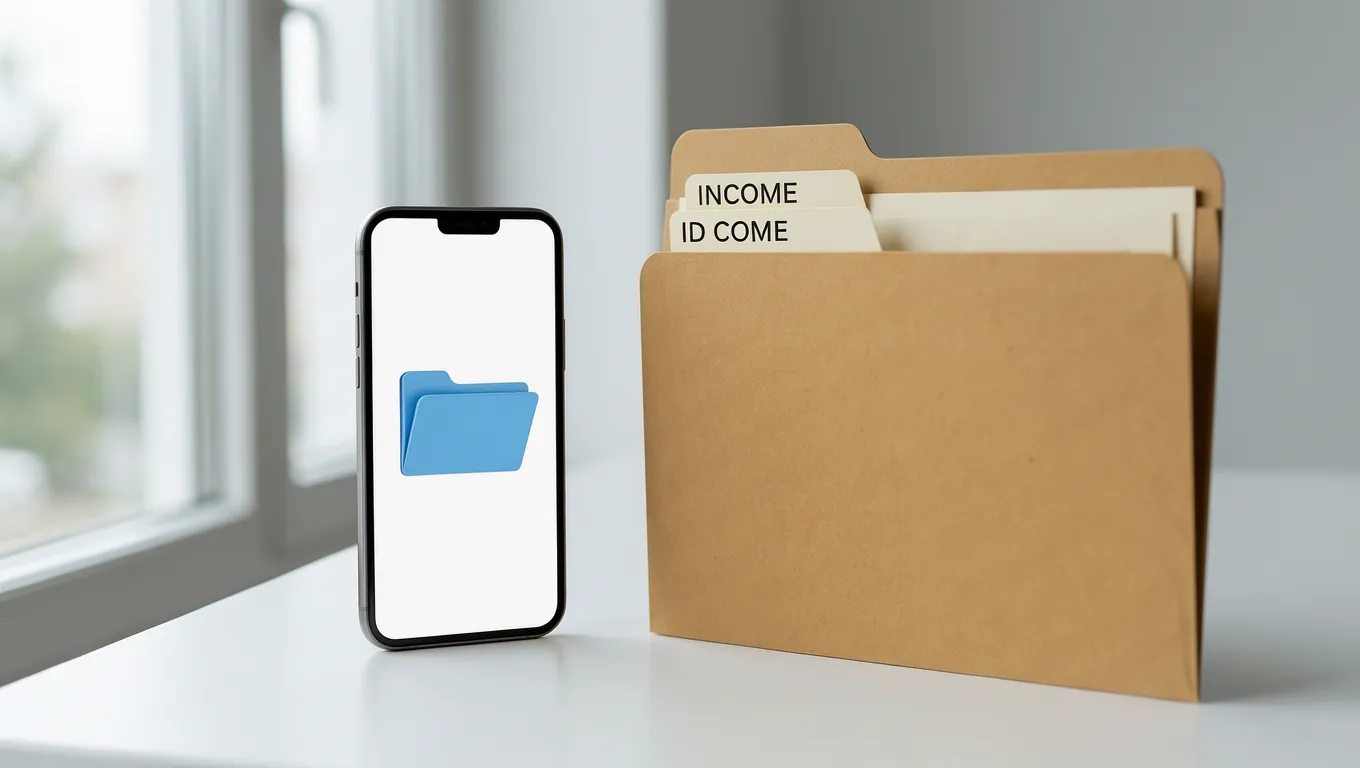
When it comes to organizing these documents, you face a choice between two primary strategies: the Digital Vault or the Physical Binder. Both have distinct advantages and trade-offs depending on your lifestyle and technological comfort.
The Digital Vault involves scanning every document into a secure, encrypted cloud storage system (like a password-protected folder in a major cloud service). The advantage here is speed; when a lender asks for a document, you can upload it instantly from any device. The trade-off is the security responsibility—you must ensure your digital files are protected by multi-factor authentication to prevent unauthorized access to your sensitive data.
The Physical Binder approach involves keeping every original or printed copy in a dedicated folder. This is excellent for people who prefer tactile organization and want to avoid 'digital fatigue.' However, the trade-off is speed and portability; if you are applying via a mobile app, you will have to find a scanner or take photos of your physical papers anyway.
Even the most organized borrower can stumble over small errors that seem insignificant at first glance. Understanding these pitfalls can save you days of waiting for a 're-submission' request.
The first major pitfall is the 'Outdated Document' error. Lenders often require bank statements from the last 60 or 90 days. Providing statements from four months ago might seem sufficient to you, but it fails to show your most recent financial stability in the eyes of an underwriter. Similarly, ensure that any proof of income is current; a paystub from three months ago is no longer valid evidence of your current ability to repay.
The second pitfall involves name discrepancies. If your bank account is under 'Robert Smith' but your application uses 'Bob Smith,' or if your middle name is included on one document but not another, it can trigger a red flag for fraud prevention systems. Warning: Always use your full legal name as it appears on your Social Security card and government ID across all submitted documents to ensure seamless verification.
Finally, watch out for the 'Low-Resolution Trap.' In our rush to finish an application, many people take quick snapshots of their documents using a smartphone in low light. These photos often appear blurry or have shadows that obscure critical numbers like account balances or transaction dates. If you can't read it clearly on your own screen, a lender's automated system won't be able to either.
Not everyone has a standard 9-to-5 job with a predictable paycheck. If you are self-employed, a freelancer, or have significant rental income, the documentation requirements change significantly. This is where many applications hit their first major roadblock.
For those who are self-employed, lenders typically won't rely on just your bank deposits; they will want to see your full tax returns (specifically Schedule C) from at least the last two years. They are looking for 'Net Profit,' not gross revenue. For example, if you brought in $100,000 in revenue but had $80,000 in business expenses, the lender sees only $20,000 of income available for your personal loan obligations.
Another edge case involves 'Variable Income' such as bonuses or overtime. If you rely on a large annual bonus to qualify for a certain loan amount, be prepared to show that this bonus has been consistent over the last two years. A single large deposit from a one-time source is rarely enough to count towards your qualifying income.
If you find yourself in these complex situations, it may be helpful to consult with a financial professional or use resources like the Consumer Financial Protection Bureau (CFPB) to understand how lenders evaluate non-traditional income. Being proactive and having your profit-and-loss statements ready before you even hit 'apply' can make all the difference in getting a timely decision.